Deep Engraving of Mould Tool Inserts – for Plastic Mould Components
Deep engraving of mould tool inserts is a specialised process used to create detailed and precise designs on the surfaces of moulds. This technique is essential in industries such as automotive, aerospace, medical devices, and consumer goods, where intricate patterns and high precision are required. In this article, we will explore the process of laser deep engraving, its benefits, and its applications in manufacturing.
We are seeing an increasing number of enquiries, from companies needing insert moulding solutions, particularly custom deep engraving of mould tools inserts or directly onto the mould tool. In the example shown, the test block shows three depth samples for the customer.
Under normal circumstances, deep laser engraving is not a commercially viable option due to the length of time the process takes. However, in the case of mould tool inserts and mould tools, the time and cost of currently producing them, makes the deep laser engraving process very competitive. In most cases the total cost being below £100 per insert for deep laser engraving. In addition, the solution is a single process which means that turnaround times are much quicker than more traditional methods.
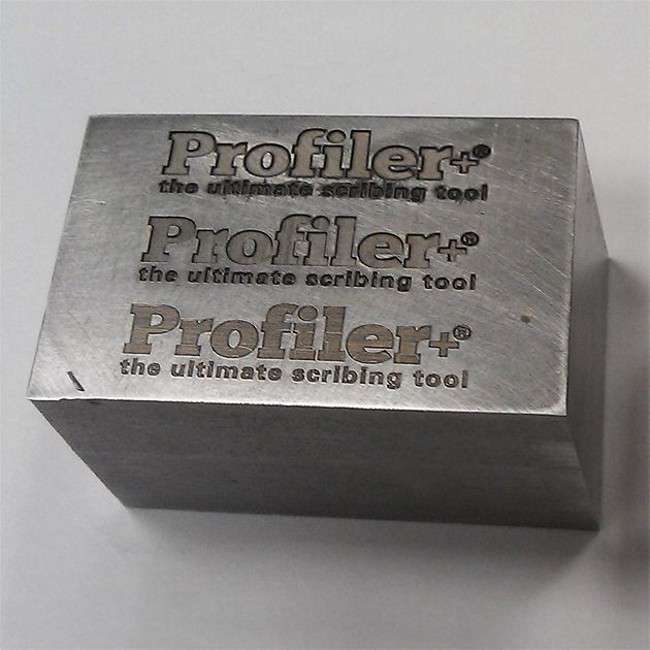
The process involves the laser removing very thin layers of material, as it reproduces the image in multiple passes. With a laser spot size of less than 150 microns, the definition (we are told) is better, especially on smaller characters, and the surface finish in the profile is more than acceptable.
Using the laser parameters, we can select power, speed and the beam overlap criteria, to finish off the profile with fine surface finishes. By optimising the power, we are able to control the heat generation, so that there is no distortion created and by controlling pulse and overlap detail, we minimise the amount of raisure normally associated with deep engraving (raisure is a burr type effect created around the edge of the image).
Many of the areas for inserting information are not flat, as in the image. While there are some restrictions with marking onto curved surfaces, it does work and if controlled, creates more than acceptable results.
Applications for Deep Engraving of Mould Tool Inserts
1. Automotive Industry
In the automotive industry, deep engraving is used to create detailed designs and patterns on interior and exterior components, such as dashboards, trim pieces, and emblems. The precision and durability of deep engraving make it ideal for automotive applications.
2. Aerospace Industry
Aerospace manufacturers use deep engraving to create precise features on components such as turbine blades, engine parts, and structural elements. The ability to produce intricate designs with high accuracy is crucial for ensuring the performance and safety of aerospace products.
3. Medical Devices
In the medical device industry, deep engraving is used to create detailed markings, logos, and functional features on surgical instruments, implants, and diagnostic equipment. The precision and durability of deep engraving are essential for meeting stringent regulatory requirements.
4. Consumer Goods
Manufacturers of consumer goods use deep engraving to add intricate designs and branding elements to products such as electronics, appliances, and luxury items. The enhanced aesthetics and customisation options offered by deep engraving help differentiate products in a competitive market.
5. Industrial Manufacturing
In industrial manufacturing, deep engraving is used to create functional patterns and textures on mould tool inserts for applications such as injection moulding, casting, and stamping. The precision and durability of deep engraving improve the performance and longevity of moulds.
If you would like further information on this application, or any other application, please request a call back or, talk to one of our laser marking specialists by going to our contact page – link below.
Contact Us for Laser Engraving, Marking & Cutting Advice (thinklaser.theprogressteam.com/)