In the aerospace industry, precision, reliability, and traceability are paramount. With stringent regulations and the need for comprehensive maintenance records, the ability to trace individual components throughout their lifecycle is critical. Laser marking of 2D matrix codes on aircraft parts has emerged as a robust solution for achieving unparalleled traceability, offering numerous advantages over traditional marking methods.
What are 2D Matrix Codes?
2D matrix codes, such as Data Matrix and QR codes, are machine-readable patterns consisting of black and white cells arranged in a square or rectangular grid. These codes can store a significant amount of information in a compact space, including:
- Part numbers
- Serial numbers
- Manufacturing dates
- Maintenance histories
When applied to aircraft components, these codes provide a digital link to essential records, enabling seamless tracking and verification.
Real Life Example of Using Laser Marking of 2D Matrix Codes
The process area is a curved surface, and therefore care must be applied when setting up and marking. 2D matrix codes are used, as part of this traceability requirement. The text height is 2mm. As required by our customer Glentworth Precision Engineering UK
The tooling allows for the part to be set up, with the focal point of the laser set half way between the maximum and minimum height positions relative to the marking area. This reduces any potential distortion, created when the focal position moves in and out of focus, around the radius during the marking process.
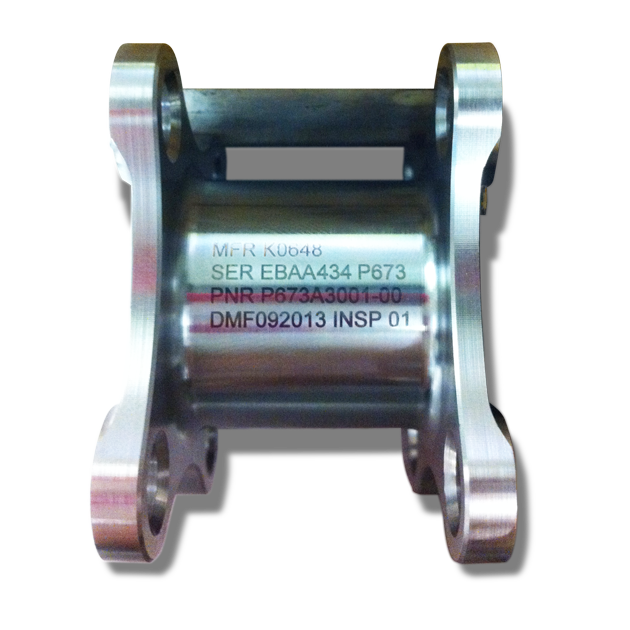
The fibre marking process, allows for the image to be produced to almost a black contrast level. Referred to as annealing, the mark element of the material is heated up, creating the colour change. No material is vaporised during the process. The laser marking is permanent, due to the discolouring taking place to a depth of probably around the 10 – 20 micron level. This process only works on steel based products, and effectively is the surface oxidising.
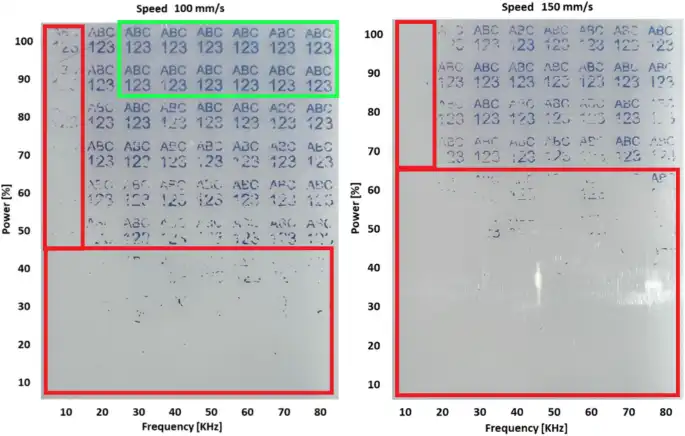
As fibre lasers can pulse at very high rates, it is possible to run the system very fast, developing multiple passes, to build up the darkness and depth of the laser marking, and still achieve commercially acceptable per unit rates.
The Role of Laser Marking
Laser marking is the process of using a focused laser beam to create permanent, high-contrast markings on a surface. For aerospace applications, fibre lasers are commonly used due to their precision, reliability, and ability to mark a wide range of materials, including metals, composites, and ceramics.
Advantages of Laser Marking for Aircraft Components
- Durability: Laser markings are resistant to extreme environmental conditions, including high temperatures, corrosive environments, and abrasion. This ensures the longevity of the 2D matrix codes, even in harsh operating conditions.
- Precision: The fine focus of the laser beam enables the creation of intricate and precise markings without damaging the underlying material. This is particularly important for small or delicate components.
- Permanence: Unlike labels or ink-based markings, laser markings cannot be easily removed or tampered with, ensuring traceability throughout the component’s lifecycle.
- Non-Contact Process: Laser marking is a non-contact process, meaning there is no physical force applied to the part. This minimises the risk of mechanical damage during the marking process.
- Speed and Efficiency: Laser systems can mark components quickly and consistently, making them ideal for high-volume production environments.
- Customisation: Laser marking systems can be easily programmed to mark different codes, text, or graphics, providing flexibility for manufacturers with diverse product lines.
Applications in Aircraft Part Traceability
The use of laser-marked 2D matrix codes is particularly beneficial in the following areas:
1. Manufacturing
During production, each component can be marked with a unique 2D matrix code that links to manufacturing data, quality control records, and supplier details. This enables manufacturers to maintain detailed records and quickly identify any issues in the supply chain.
2. Maintenance, Repair, and Overhaul (MRO)
In the MRO phase, 2D matrix codes allow technicians to quickly access the history of a component, including previous repairs, inspections, and replacements. This streamlines maintenance processes and ensures compliance with regulatory standards.
3. End-of-Life Management
At the end of an aircraft part’s lifecycle, 2D matrix codes provide vital information for proper disposal or recycling. This supports sustainable practices and helps manufacturers comply with environmental regulations.

Compliance with Aerospace Standards
Laser marking of 2D matrix codes meets the rigorous requirements of aerospace standards such as AS9100 and the Department of Defence’s UID (Unique Identification) policy. These standards mandate the use of permanent and machine-readable markings for effective part identification and traceability.
Conclusion
The adoption of laser marking of 2D matrix codes, and permanent markings, laser marking systems ensure that aircraft components can be accurately identified and tracked throughout their lifecycle. For manufacturers and MRO providers, this technology not only enhances operational efficiency but also strengthens compliance with industry regulations.
As the demand for traceability continues to grow, investing in advanced laser marking systems is a strategic move for aerospace companies seeking to optimise their processes and maintain the highest standards of quality and safety.
If you would like further information on this application, or any other application, please request a call back or, talk to one of our laser marking specialists by going to our contact page – link below.
Contact Us for Laser Engraving, Marking & Cutting Advice (thinklaser.theprogressteam.com/)