The medical industry demands the highest standards in traceability, precision, and durability for its devices. Laser marking has become a crucial technique in meeting these standards, especially for products like inhalers. Thinklaser Limited recently undertook a project involving the laser marking of ABS (Acrylonitrile Butadiene Styrene) inhalers. In this case study, we will explore the process, challenges, and benefits of using laser marking for medical devices, specifically for ABS inhalers.
Project Overview
The customer approached Thinklaser Limited with a requirement to mark ABS inhalers with critical product information, including batch numbers, serial codes, and branding details. The goal was to ensure that the markings were permanent, precise, and readable, even after the inhalers had been subjected to everyday use and sterilisation processes.
ABS is a commonly used plastic in medical devices due to its strength, durability, and lightweight properties. However, achieving high-contrast and permanent markings on ABS without compromising its structural integrity required the precise capabilities of our advanced galvo laser systems.
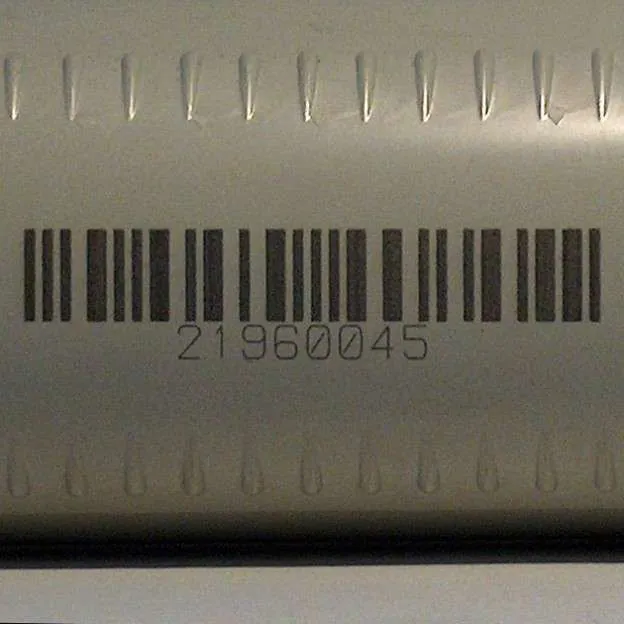
The laser marking of ABS process is used to place a barcode 39 image onto the materials main body for data storage and traceability. The contrast achieved, provides good reads from the scanning systems used both in industrial and retail decoding. The barcode is laser marked along the length, to minimise any distortion by the part being tubular. Grey pigmentation within the plastic material, creates the best level of definition for lasers onto plastics such as this.
There are a number of differing changes to the plastic material surface during laser marking, and it is very dependent on the material itself as to which one occurs.
- A thermochemical foaming, creating gas bubbles to the surface of the material, is the most common. The light scatters across the affected area producing the light marking that appears.
- Bleaching is another effect that is common. Here the pigment used to achieve the product colour is removed creating a visual difference.
- The third mechanism is vaporisation, where the material is heated very quickly, to the point where it vaporises and is removed leaving behind the created image.
These three laser marking effects, can be enhanced by the adding of laser sensitive additives and can generate considerable advantages. The additive acts as an absorption barrier, boosting the ability of the laser to process better. In some materials, the laser marking ability would not be possible without this additive. The laser marking of ABS Inhalers is just one of many applications available for this technology
The Laser Marking Process
For this project, we utilised our jobshop galvo laser systems, specifically designed to handle a variety of materials with precision. The laser marking process involved the following steps:
1. Material Preparation
Before marking, the ABS inhalers were cleaned to ensure that no contaminants or residues would interfere with the laser’s accuracy. A clean surface is essential to produce high-quality, consistent markings on plastic materials.
2. Optimising Laser Settings
We optimised the laser parameters—such as power, speed, frequency, and focus—to achieve a clear and durable mark on the ABS surface. The settings were fine-tuned to avoid any thermal damage or discolouration of the material, ensuring that the markings were sharp and legible.
3. Marking Execution
The laser marking was executed using a pulsed fibre laser, ideal for marking plastics like ABS. This technology allowed us to create high-contrast markings without burning or distorting the material. The result was a smooth, clear mark that met the stringent requirements for medical device labelling.
4. Quality Control
Each inhaler was inspected for mark clarity, consistency, and durability. The markings were tested to ensure they would remain legible after repeated handling, exposure to moisture, and various sterilisation processes common in medical environments.
Challenges and Solutions
1. Avoiding Material Deformation
ABS can be sensitive to high temperatures, which could lead to warping or melting if not handled properly. To prevent this, we carefully controlled the laser’s pulse duration and intensity, ensuring that the energy delivered was sufficient to create a mark without damaging the plastic.
2. Achieving Consistent Marking on Curved Surfaces
Marking on the curved surface of the inhaler presented a challenge in maintaining uniformity. Using our jobshop galvo laser system’s advanced control features, we ensured that the laser beam maintained a consistent focus across the inhaler’s contours, resulting in evenly distributed, clear markings.
Benefits of Laser Marking for ABS Inhalers
Laser marking offers several distinct advantages for medical devices, especially when compared to traditional marking methods:
- Permanent and Non-Degradable Marks: Laser marks on ABS inhalers are resistant to wear, chemicals, and sterilisation processes, ensuring they remain legible throughout the product’s lifecycle.
- High Precision and Accuracy: The Lightblade laser system provides excellent precision, ideal for marking small, detailed information required on medical devices.
- Non-Contact Process: As a non-contact method, laser marking prevents any mechanical damage to the ABS material, maintaining the structural integrity of the inhaler.
- Environmentally Friendly: Laser marking does not require the use of inks or chemicals, making it a cleaner and more sustainable marking solution.
FAQs
1. Why is laser marking preferred for medical devices like inhalers?
Laser marking is preferred for medical devices due to its ability to create permanent, high-contrast markings that do not degrade over time. It ensures that critical information, such as batch numbers and serial codes, remains legible even after extensive use and sterilisation.
2. Will the laser marking affect the functionality of the ABS inhaler?
No, laser marking is a non-contact process that does not alter the structural integrity of the ABS material. The process is designed to ensure that the inhaler’s functionality remains completely unaffected while providing durable and clear markings.
3. How durable are the laser markings on ABS inhalers?
The laser markings on ABS inhalers are highly durable and resistant to wear, moisture, and chemical exposure. They are designed to withstand the rigours of everyday use and the repeated cleaning and sterilisation processes typical in medical environments.
Conclusion
The successful laser marking of ABS inhalers showcases Thinklaser Limited’s expertise in delivering precise and durable marking solutions for the medical industry. Our laser systems provide the accuracy and reliability required to meet the stringent demands of medical device manufacturers.
If you have a requirement for laser marking on medical devices or any other products, please get in touch with Thinklaser Limited. We are here to offer tailored solutions that meet your specific needs and industry standards.
Get in Touch
For more information about our laser marking capabilities or to discuss your next project, please contact us today. We look forward to providing you with the best possible marking solutions for your products!
Contact Us for Laser Engraving, Marking & Cutting Advice (thinklaser.theprogressteam.com/)
