Understanding Laser Marking Curved Surfaces
How It Works
Laser marking involves the use of a focused laser beam to alter the surface of a material, creating marks that can be seen visually or detected by machines. When dealing with curved surfaces, the laser marking process becomes more complex, as the laser must maintain consistent focus and power across the changing geometry of the object.
Laser marking curved surfaces is common place on industrial products today. As long as the basic rules are followed it is a fairly easy process to complete.
Challenges in Laser Marking Curved Surfaces
1. Maintaining Focus
One of the primary challenges in laser marking curved surfaces is maintaining a consistent focus across the entire marking area. Any deviation can result in uneven markings or loss of detail.
2. Distortion and Perspective
When marking curved surfaces, distortion can occur if the laser does not properly compensate for the surface’s shape. This requires advanced software to adjust for perspective changes, ensuring that the markings appear correctly from all angles.
3. Material Variability
Different materials can respond differently to laser marking, especially on curved surfaces. Factors such as reflectivity, absorption, and surface finish can impact the marking quality and need to be considered during the process.
Real World Application
In this example by our customer Custom Divers, the material is aluminium which absorbs the laser energy very well, making laser marking on its curved surface much easier.
The laser has a focal position, which is where both the spot size and energy levels are optimised. But in this instance, we have to set the laser focal position half way between the upper and lower mark positions. This takes out any potential distortion to the image, as it is applied and ensures the energy available, does not vary so much that the intensity of the image is affected.
Laser marking curved surfaces is common place on industrial products today. As long as the basic rules are followed it is a fairly easy process to complete.
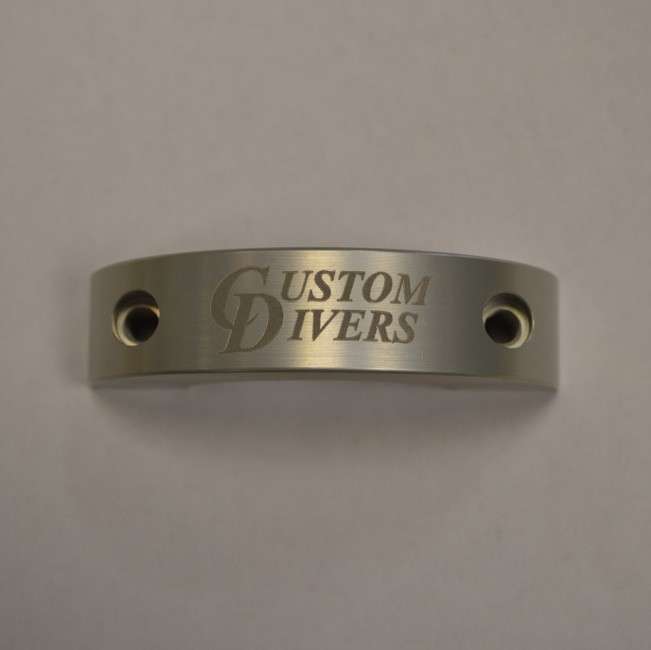
The fill line orientation is also important. To maximise the contrast levels, we always set the scan fill line to be perpendicular to any machining marks on the components. Some anodised layers can be processed by selectively removing the dyes from the anodised layers, effectively bleaching them while leaving the anodised material intact. Careful pulse parameter selection is required, to ensure that the layer is bleached but with no removal of the oxide. Typically, short duration pulses are required with high peak powers and low pulse energy.
PRO TIP: There is a general rule when laser marking on curved surfaces. You stay within a 20 degree segment on the circumference, if working with harder and more reflective materials, and 25 degrees if softer and less reflective.
Techniques for Marking Curved Surfaces
- 3D Laser Marking Systems: These systems are specifically designed to handle the complexity of curved surfaces. They use advanced software and hardware to adjust the laser’s focal point and intensity dynamically, ensuring consistent marking quality across different surface angles.
- Rotary Attachments: For cylindrical objects, rotary attachments rotate the item during the marking process, allowing the laser to maintain consistent focus and marking quality. This method is particularly useful for items like tubes, bottles, and pipes.
- Adjustable Focus Optics: These optics allow the laser beam to maintain focus on uneven surfaces, enabling consistent marking depth and quality on curved profiles.
Applications of Laser Marking on Curved Surfaces
1. Automotive and Aerospace
In the automotive and aerospace industries, laser marking is used to engrave parts with serial numbers, barcodes, and logos on components like engine parts, dials, and control panels, which often have curved surfaces.
2. Medical Devices
Medical devices frequently have complex shapes and require precise, sterile markings for identification and compliance. Laser marking provides a non-contact method that ensures markings remain clear and permanent.
3. Consumer Products
Laser marking is widely used to personalize consumer products such as jewelry, watches, and electronics. These items often have curved surfaces that benefit from the precision and durability of laser marking.
4. Packaging
Packaging for food, beverages, and pharmaceuticals often involves curved surfaces, such as bottles and cans. Laser marking provides a reliable way to apply expiration dates, batch numbers, and branding.
If you would like further information on this application, or any other application, please request a call back or, talk to one of our laser marking specialists by going to our contact page – link below.
Contact Us for Laser Engraving, Marking & Cutting Advice (thinklaser.theprogressteam.com/)
